中文
中文 English

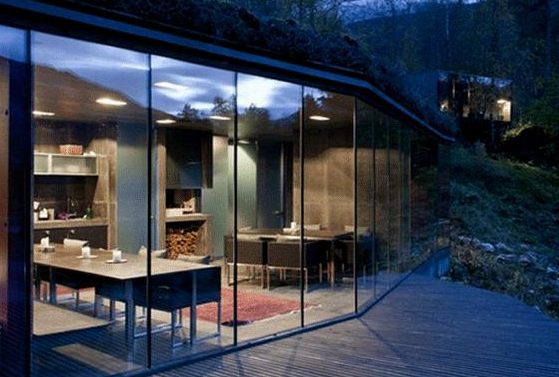
In summer, people hope to keep sunlight out as much as possible, while in winter, they want more sunlight to enter the room. Thus, dimmable glass came into being. The emergence of dimmable glass represents a revolution in the single light transmission property of ordinary glass. According to their basic working principles, they can be classified into types such as photochromic, electrochromic, thermochromic, and thermochromic. This article mainly introduces the principle of electrochromic glass.
The first principle, electrochromic glass, uses voltage to change the arrangement of liquid crystal molecules for dimming
When a layer of liquid crystal film is sandwiched between two pieces of glass and electrified, an excellent liquid crystal dimming glass film is formed. Its basic structure is that several micrometer-sized liquid crystal small boxes are collectively dispersed on the glass and sandwiched between transparent conductive films, forming a special interlayer structure. When light shines on glass, it is subjected to a strong scattering effect, thus the transparency of the glass disappears. When a voltage is applied between two layers of transparent conductive films, the liquid crystal molecules are arranged in a directional manner towards the glass surface, allowing light to pass directly and thus revealing transparency. Therefore, dimmable glass is formed.
The second principle is that electrochromic glass changes its transmittance by means of variations in the electric field
Dimmable glass utilizes the adjustable light transmission performance of electrochromic materials under the influence of an electric field to achieve the purpose of adjusting illuminance according to human will. Meanwhile, the electrochromic system can reduce a large amount of energy waste in buildings such as office buildings and residential buildings by selectively absorbing or reflecting external thermal radiation and preventing internal thermal diffusion. The function of the transparent conductive layer of dimmable glass is to form conductive glass with the base glass. The electrochromic layer, also known as the working electrode, causes the glass to undergo coloring and fading changes under the action of an external electric field. The electrolyte layer only allows ions to pass through and serves as ions in the conductive discoloration process.
With the rapid development of modern glass technology, the glass industry is also changing rapidly. People use voltage and electric fields to change the performance of ordinary glass, turning it into popular dimmable glass. Smart dimming glass can meet users' demands, providing customers with a comfortable visual experience anytime and anywhere, and greatly facilitating people's lives.