中文
中文 English

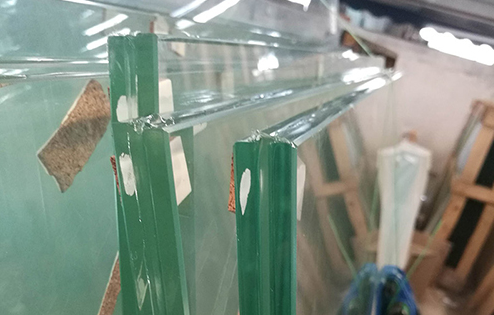
An effective way to reduce the "self-explosion" of tempered glass is: hot-dip treatment. Hot-dip treatment, also known as homogenization treatment, is commonly called "detonation". Hot-dip treatment involves heating tempered glass to 290℃±10℃ and maintaining it for a certain period of time to accelerate the crystal phase transformation of nickel sulfide within the tempered glass. This causes the tempered glass, which would otherwise shatter prematurely after use, to break in the factory's hot-dip furnace, thereby reducing the risk of self-explosion of tempered glass during use after installation.
The explanation of hot-dip coating by tempered glass manufacturers
In principle, hot-dip treatment is neither complicated nor difficult. But in fact, it is extremely difficult to achieve this technological index. Research shows that there are various specific chemical structural formulas of nickel sulfide in glass, such as Ni7S6, NiS, NiS1.01, etc. Not only do the proportions of various components vary, but they may also be mixed with other elements. The speed of its phase transition is highly dependent on the level of temperature. Research shows that the phase transformation rate at 280℃ is 100 times that at 250℃. Therefore, it is necessary to ensure that each piece of glass in the furnace undergoes the same temperature system. Otherwise, on the one hand, the low-temperature glass, due to insufficient holding time, the nickel sulfide cannot basically undergo phase transformation, thus weakening the effectiveness of hot immersion.
On the other hand, when the temperature of the glass is too high, it may even cause the reverse phase transformation of nickel sulfide, creating even greater hidden dangers. Both of these situations can lead to the hot-dip treatment being ineffective or even counterproductive. The uniformity of temperature during the operation of a hot-dip furnace is so crucial. Three years ago, the temperature difference inside most domestic hot-dip furnaces during hot-dip holding even reached 60℃, and it was not uncommon for imported furnaces from abroad to have a temperature difference of around 30℃. Therefore, even though some tempered glass has undergone hot-dip treatment, its self-explosion rate remains high.
In fact, the hot-dip process and equipment have been constantly improved. In the 1990 edition of the German standard DIN18516, the insulation time was stipulated as 8 hours, while the prEN14179-1:2001 (E) standard reduced the insulation time to 2 hours. Under the new standard, the effect of the hot-dip process is very significant, and there are clear statistical technical indicators: after hot-dip, it can be reduced to one case of self-explosion per 400 tons of glass. On the other hand, the design and structure of the hot-dip furnace are constantly being improved, and the uniformity of heating has also been significantly enhanced, basically meeting the requirements of the hot-dip process. For instance, the self-explosion rate of the hot-dip treated glass from Nanshan Glass Group has reached the technical indicators of the new European standards, and it has performed extremely satisfactorily in the 120,000-square-meter super-large project of the new Guangzhou Airport.
Although hot-dip treatment cannot guarantee that self-explosion will not occur, it does reduce the occurrence of self-explosion and effectively solves the self-explosion problem that has long plagued all parties involved in the project. Therefore, hot-dip treatment is unanimously recognized worldwide as a relatively effective method to solve the problem of self-explosion.